Compress PDF and Reduce File Size
ReadyChoose image quality to reduce the size of a PDF file. Compare the output for screen viewing or printing and check that small text remains readable.
All tools are free to use. File size and processing limits may vary by tool.
How to use Compress PDF
Keep an original copy and upload the PDF. Try 150 DPI for screen reading and email. Choose 300 DPI for fine print or printing; 72 DPI can lose more detail. Download the result, compare its size and zoom into a page containing small text.
Browser tools keep files on your device. Advanced document tools upload files for temporary server processing; the tool shows this before upload. Web lookups send queries to the server and public lookup services.
Shrinking a PDF while keeping it readable
What bloats a PDF is rarely the text; it is high-resolution photos and scanned pages. Compression reprocesses those images at the quality you choose, so every document shrinks differently. A text-heavy or already compressed file may barely shrink and can even grow slightly when resaved. Choose by use, not by size alone: 150 DPI is usually enough for screen reading and e-mail; small-print contracts or print jobs need 300 DPI; 72 DPI is a last resort.
Read the guide →Practical articles on this topic
PDF Compression: Balancing File Size and Readability
A smaller PDF is useful only if it remains readable. Image-heavy and text-heavy documents compress differently.
Best Free Online Tools in 2026: Complete Guide
Choosing the right tool for repetitive digital tasks saves time. This guide lists the best free online tools in 2026 by category.
Try a real example file
This document was created for demonstration and contains no customer or employee data. Download the input and actual tool output to compare them.
Example checked on:
At 150 DPI this example did not get smaller: the output is slightly larger. An already compressed PDF may not shrink; compare size and readability.
Settings used in this run
- Quality
- 150 DPI
Checks on this example
- Input pages
- 1
- Output pages
- 1
- Input size (bytes)
- 112212
- Output size (bytes)
- 113843
- Rendered pages
- 1
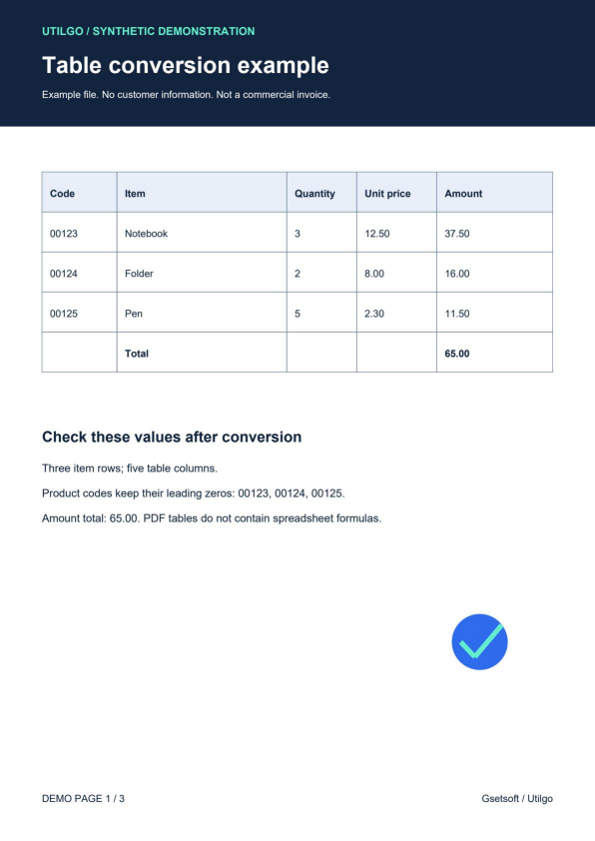
Only the example below was verified. Other files may produce different layouts or results; keep the original.
Related tools
Merge PDF
Combine multiple PDFs into a single file. Arrange reports and attachments, join the PDFs in your browser and download the result without uploading the files.
Split PDF
Separate a multipage PDF into individual one-page PDF files. Process the document in your browser and download a ZIP without uploading the source.
PDF to Word
Turn a PDF into a Word document. Choose editable text, tables and images, or preserve page appearance by placing each page into Word as an image.
Word to PDF
Turn a Word document into a PDF file. Upload DOC or DOCX, then inspect fonts, page breaks and table alignment in the downloaded document.
PDF to JPG
Turn PDF pages into JPG images. Up to 30 pages and 12 megapixels per page are supported; a single page downloads as JPG, more as ZIP. Files are processed in this browser and never uploaded.
JPG to PDF
Combine JPG images into a single PDF document. JPEG only, up to 40 megapixels per image. Files are processed in this browser and never uploaded.
Continue with this PDF
Send the completed PDF to compression, page extraction, rotation, watermarking or numbering without selecting it again. Filled forms can also go to flattening. You start each step; modifying a document may affect digital signatures. Split-result ZIP files are not transferred.
Transfer happens between open tabs; we do not save the file in browser storage for this. This step does not start a new upload. Choosing server processing in the destination uploads the file again; its size limit applies.